
By Jillian F. Hayes, Esq. · Last updated May 20, 2026
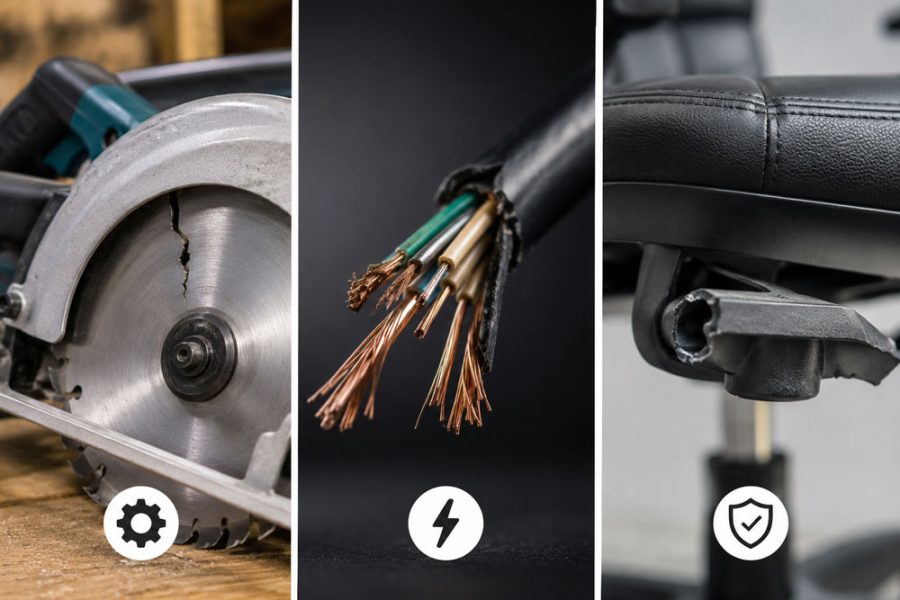
California law recognizes three types of product defects: design defects, manufacturing defects, and warning defects (also called failure-to-warn or marketing defects). Each can independently support a strict product liability claim under Greenman v. Yuba Power Products (1963) and the framework set out in Barker v. Lull Engineering (1978). A design defect means the product is dangerous as designed. A manufacturing defect means a specific unit came off the line with a flaw. A warning defect means the product was sold without adequate disclosure of a known risk. Many cases involve more than one defect type. Identifying which categories apply is one of the first jobs of a product liability attorney.
Injured by a defective product? Hayes Law evaluates all three defect theories during a free consultation.
Get a Free Case ReviewWhy the Categories Matter
The three defect categories are not just academic labels. Each has its own legal test, its own evidentiary requirements, and its own typical defenses. The classification affects how a case is investigated, who the experts are, what documents matter in discovery, and how the case is presented to a jury.
A design defect case requires expert engineering testimony about safer alternative designs. A manufacturing defect case requires comparison of the injuring product against the manufacturer's specifications and other units. A failure-to-warn case requires analysis of what the manufacturer knew, when it knew, and what an adequate warning would have looked like.
Type 1: Design Defects
A product is defectively designed if its inherent design makes it unreasonably dangerous, even when manufactured perfectly. Every unit produced from that design carries the same risk. This is the broadest and often the most consequential defect type because it can affect thousands or millions of products.
The Barker Tests
The California Supreme Court's 1978 decision in Barker v. Lull Engineering, 20 Cal.3d 413, set out two alternative tests for design defect. The Soule v. General Motors decision in 1994 clarified when each applies.
The Consumer Expectations Test. A product is defectively designed if it failed to perform as safely as an ordinary consumer would expect when used in a reasonably foreseeable manner. The test asks: did the product behave the way a normal user would assume it would behave? This test works for products where consumer expectations are clear.
Example: An ordinary consumer expects a kitchen knife to cut without the blade snapping off. An ordinary consumer expects a child's stroller wheel to stay attached during normal use. When that doesn't happen, the consumer expectations test does the work.
The Risk-Benefit Test. When the plaintiff shows the design caused the injury, the burden shifts to the manufacturer to prove the design's benefits outweigh its risks. The jury weighs factors including:
- The gravity of the danger posed by the design
- The likelihood the danger would cause injury
- The mechanical feasibility of a safer alternative design
- The financial cost of the safer design
- The adverse consequences to the product and consumer of the safer design
The risk-benefit test is used when consumer expectations aren't reliable for the product (a complex industrial machine, a medical device, a chemical product). The burden-shifting structure makes it a powerful tool for plaintiffs.
Real case: In Soule v. General Motors, the California Supreme Court held that a 1982 Camaro's front wheel design and floorboard configuration could be evaluated under the risk-benefit test for an alleged design defect that caused severe ankle injuries in a side-impact collision. The case clarified that complex automotive design cases generally call for risk-benefit analysis rather than pure consumer expectations.
Examples of Design Defect Claims
- Vehicle fuel tanks placed in positions that increase fire risk in collisions
- Power tools without standard safety guards
- Medications with side effect profiles that exceed benefit profiles for the indicated use
- Children's furniture with stability profiles that allow tipping
- Lithium-ion battery designs prone to thermal runaway under normal charging conditions
Type 2: Manufacturing Defects
A manufacturing defect exists when the product's design is safe but a specific unit was made wrong. The defect is in the individual product, not in the entire product line. Strict liability applies, but the plaintiff has to prove that the injuring unit deviated from the manufacturer's intended specifications.
How Manufacturing Defects Are Proven
The classic proof method is to compare the injuring product against:
- The manufacturer's own design specifications and drawings
- Other units from the same production run
- Industry standards for the product category
An expert witness, typically a manufacturing engineer or product safety specialist, examines the product and identifies the deviation. Photographs, microscopic analysis, and destructive testing are common. Maintaining the chain of custody for the injuring product is critical.
Historical context: Justice Roger Traynor's 1944 concurrence in Escola v. Coca Cola Bottling Co., 24 Cal.2d 453, laid the philosophical groundwork for strict liability in manufacturing defect cases. The case involved an exploding Coca-Cola bottle. Traynor argued that the bottling company was in the best position to prevent and insure against such defects, and the law should hold it liable without requiring proof of negligence. That reasoning became the foundation of Greenman two decades later.
Examples of Manufacturing Defect Claims
- A car with a missing or defective weld in the frame
- A medical implant with material contamination from the manufacturing process
- A food product with foreign objects (glass, metal fragments) introduced during packaging
- A medication batch with the wrong active ingredient dose
- A bicycle component cast with an internal void that fails under normal stress
If your case involves an unusual product failure, the unit itself may be the most important evidence. Preserve it. Then call Hayes Law for a free review.
Schedule a Free ConsultationType 3: Warning Defects (Failure to Warn)
A product has a warning defect when it carries a risk that could be reduced or eliminated by an adequate warning, and the manufacturer failed to provide one. Some products are unavoidably dangerous (prescription drugs, power tools, household chemicals) and the law accepts that. What the law requires is that consumers be told about the danger so they can make informed decisions.
What Makes a Warning Adequate
An adequate warning under California law has to:
- Identify the specific hazard, not generic dangers
- Communicate the magnitude of the risk
- Be conveyed in a manner reasonably likely to reach the foreseeable user
- Be physically positioned where the user will see it before encountering the hazard
- Be in language the user can understand
A label that says "use with caution" doesn't warn about a specific risk. A warning buried on page 47 of a user manual isn't reasonably likely to reach the user. A warning in English on a product marketed to Spanish-speaking consumers may not be adequate.
The Learned Intermediary Doctrine
For prescription drugs and some medical devices, California applies a modified rule called the learned intermediary doctrine. The manufacturer's duty to warn runs to the prescribing physician rather than directly to the patient. The theory is that doctors are positioned to understand the medical risks and counsel patients accordingly.
The doctrine has limits. If the manufacturer fails to warn the physician adequately, the manufacturer can still be liable. The California Supreme Court applied this framework in T.H. v. Novartis Pharmaceuticals Corp., 4 Cal.5th 145 (2017), in the context of generic drug manufacturers and brand-name innovators.
Examples of Failure-to-Warn Claims
- Prescription drugs without disclosure of known serious side effects
- Power tools sold without adequate safety operating instructions
- Household chemicals without warnings about respiratory hazards in unventilated spaces
- Children's toys without age-appropriate hazard warnings
- Electronics without disclosure of known overheating or fire risks
- Asbestos products sold without warnings about cancer risk (litigated extensively in Anderson v. Owens-Corning Fiberglas Corp., 53 Cal.3d 987 (1991))
Side-by-Side Comparison of the Three Defect Types
| Element | Design Defect | Manufacturing Defect | Warning Defect |
|---|---|---|---|
| What's defective | The blueprint | The individual unit | The warning or instruction |
| How many products affected | Entire product line | One or a small batch | Entire product line (warning is uniform) |
| Legal test | Consumer expectations OR risk-benefit (Barker) | Deviation from intended specifications | Whether the warning was adequate |
| Key expert | Design engineer | Manufacturing engineer | Industry standards expert, sometimes medical/scientific expert |
| Common defense | Design met state of the art; benefits outweigh risks | Product alteration after sale; not the injuring unit | Warning was given; user ignored it; learned intermediary |
When a Single Case Involves Multiple Defect Types
Most product liability complaints plead all three defect categories. The pleading is essentially: "This product was defectively designed. If the design was fine, this particular unit was defectively manufactured. And in any event, the warnings were inadequate." Each theory survives or falls on its own.
Example: A consumer injured by a lithium battery fire might claim:
- Design defect (the cell chemistry and venting design create unreasonable thermal runaway risk)
- Manufacturing defect (this particular battery had a manufacturing flaw that increased the risk)
- Failure to warn (the manufacturer knew of similar incidents and did not warn consumers about charging practices or storage conditions)
Pleading all three preserves all paths to recovery as discovery develops.
Frequently Asked Questions
- What are the three types of product defects in California?
- Design defects, manufacturing defects, and warning defects.
- What is a design defect under California law?
- A design defect exists when the product's design is unreasonably dangerous, even when manufactured correctly. California uses the consumer expectations test or the risk-benefit test from Barker v. Lull.
- What is a manufacturing defect?
- A manufacturing defect exists when an individual unit deviated from the intended design during production and the deviation caused the injury.
- What is a failure-to-warn defect?
- A failure-to-warn defect exists when the product carries a risk that an adequate warning could reduce, and the manufacturer didn't provide such a warning.
- What is the consumer expectations test?
- It asks whether the product performed as safely as an ordinary consumer would expect when used in a reasonably foreseeable way.
- What is the risk-benefit test?
- Once the plaintiff proves the design caused the injury, the manufacturer must prove the design's benefits outweigh its risks.
- Can a product have more than one type of defect?
- Yes. Most complaints plead all three defect types in the alternative.
- Who decides if a product is defective?
- A jury at trial, or the parties through negotiation based on their assessment of how a jury would likely rule.
Hayes Law investigates all three defect theories in San Diego product liability cases. Free consultations.
Talk to an Attorney TodayAbout the Author: Jillian F. Hayes is a San Diego product liability attorney focused on consumer goods, e-commerce, and emerging technology cases. This article provides general information about California product defect categories and is not legal advice for any specific case.